Locked out in Saint-Constant
A unit door that locks itself near the gare Sainte-Catherine does not open like the old wooden door of a house on rue Saint-Pierre. The technician chooses his method from the door, starting with the one that leaves no mark.
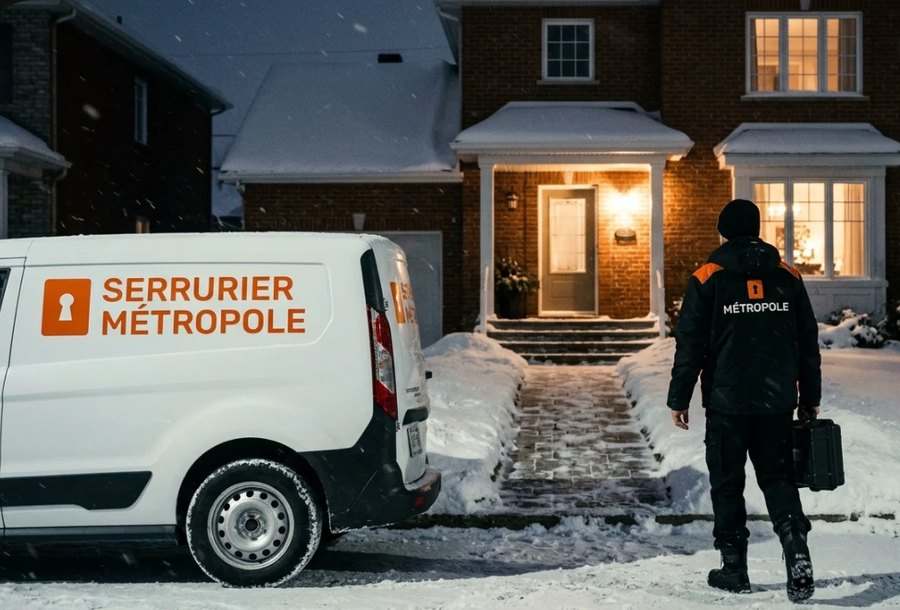
In Saint-Constant, most homes are single-family houses. You might think all locked doors there look alike. In reality the door changes from area to area: old wooden doors in the village, bungalows of the 1960s to 1980s in the north of town, recent plexes and row houses around the stations. Knowing which area you are in already helps the technician prepare his tools.
Near the gare Sainte-Catherine, the door that slams behind you
North of montée Saint-Régis and west of rue Sainte-Catherine, around the gare Sainte-Catherine, the buildings are the newest in town, and the densest: stacked row houses, duplexes, triplexes. In this kind of building, the unit door often has a handle that stays locked when pulled shut as you leave, and the shared entrance closes itself behind you.
It is the simplest situation: you go down to put out the bins or collect a parcel, the door closes, and only the latch bolt keeps you outside. The technician usually releases it without leaving a mark, sometimes with a tool slid under the door that presses down the inside lever. A keypad lock with dead batteries is the other frequent case in these recent homes; mention it on the phone.
Rue Saint-Pierre, the oldest doors in town
The village core occupies the southern part of rue Saint-Pierre, starting from the rail line, along the rivière Saint-Pierre. That is where Saint-Constant's oldest houses are. A door of that age has been planed, repainted and refitted many times, and its lock is almost never the original.
On these doors, the wood of the door jamb chips at the slightest force. The technician therefore does not force the bolt with a blade: he works the cylinder, pin by pin, until the deadbolt retracts. Around the crossing of montée Lasaline, in the heart of the village, shops add their own doors, often heavier, handled with the same care.
North of montée des Bouleaux and along Route 132
North of montée des Bouleaux and east of rue Saint-Pierre, houses date mostly from the 1960s. In the residential strip just south of Route 132, most predate the mid-1980s. These bungalows have often kept an original latch knob, completed later by a deadbolt from another series, with a different key for each.
Everything then depends on what is locked. If you left by the side door simply pulling it shut, the latch alone holds it, and the opening goes fast. If you had turned the deadbolt, the cylinder must be worked, and the time depends on its condition. A key that had been catching for months signals a lock near the end of its life: once the door is open, talk it over with the technician, and see the page on lock change in Saint-Constant.
In the farm zone, at night, in midwinter
Beyond the urban perimeter, Saint-Constant is permanent farm zone, with isolated houses lined up along the roads. Finding yourself outside there at 2 a.m. in January is nothing like the same mishap on a street of plexes: no neighbour three metres away, no shop open. Take shelter in the car or an unlocked outbuilding before calling, and do not break a window to get in. The exact arrival time is given on the phone. The guide on being locked out: what to do while you wait offers other ways to stay warm.
In deep cold, a key that refuses to go in does not always mean a locked door: the cylinder may be frozen. Do not pour hot water on it, since it refreezes in the mechanism. If it is truly a matter of keys left inside, the general page on door unlocking describes each method, from the gentlest to drilling. And if you are locked out of your car at the town's stations, the page on car lockout in Saint-Constant takes over. The other work offered is on the page of the locksmith in Saint-Constant.
Also in Saint-Constant
The service in detail, across the region: door unlocking.
The same service in nearby areas
Common questions
In my triplex near the gare Sainte-Catherine, both the shared door and my unit door are locked. Do I need two visits?
No, just one. Say so at the start of the call: the technician deals first with the door that separates you from your home. If a neighbour can let you in at the shared entrance, that is time saved, and the unit door, often held by its latch alone, generally opens without a mark.
My house in the old village has an old wooden door. Will it be damaged?
The technician avoids blades and levers against an old frame and works the cylinder by hand instead. If the lock is too worn to give, he explains it and you decide the next step with him before any drilling.
I live in an isolated house in the farm zone. Will the technician find the address at night?
Yes, as long as you help: give the road name, the street number and a landmark visible from the road, such as a mailbox or a farm building. Turn on the outside light if someone stayed inside or a neighbour can do it.